
Author: Avni Dalal, ND
Genomic testing has transformed personalized healthcare, but as science evolves, so must clinical interpretation.
A single genetic variant rarely tells the full story. Most health outcomes are polygenic—driven by the additive effects of thousands of genetic variants interacting with nutrition, lifestyle, environmental exposures, age, and epigenetics.[1–3] Evaluating single SNPs in isolation can lead to fragmented insights and oversimplified clinical conclusions.
However, the greatest clinical value of genomic testing may not lie in predicting exactly what will happen to a patient, but rather in answering a more practical question: Where should we pay closer attention?
To help answer this question, DNA Signature from Mosaic Diagnostics introduces a next-generation suite of genomic profiles combining polygenic risk scoring (PRS) with actionable clinical interpretation. Rather than predicting outcomes, DNA Signature provides a clear baseline map of a patient’s unique genetic predispositions—helping you prioritize dietary, lifestyle, targeted supplementation, and functional testing strategies.
The Clinical Limitation of Single-SNP Analysis
In integrative and functional medicine, single nucleotide polymorphisms (SNPs) have traditionally been evaluated by one gene at a time (e.g., MTHFR, COMT). While individual high-penetrance variants matter, common traits and metabolic pathways have a complex genetic architecture.[1–3]
Evaluating isolated SNPs presents clear clinical limitations:
- Confounding Variants: A patient may carry one variant associated with increased susceptibility alongside multiple unrecognized variants that mitigate or offset that risk.
- Over-Interpretation: A SNP indicates biological predisposition, not current physiological status or active pathway dysfunction.
- False Precision: Treating a single SNP as a clinical “on/off switch” overlooks the broader network of genetic and non-genetic factors driving phenotype.
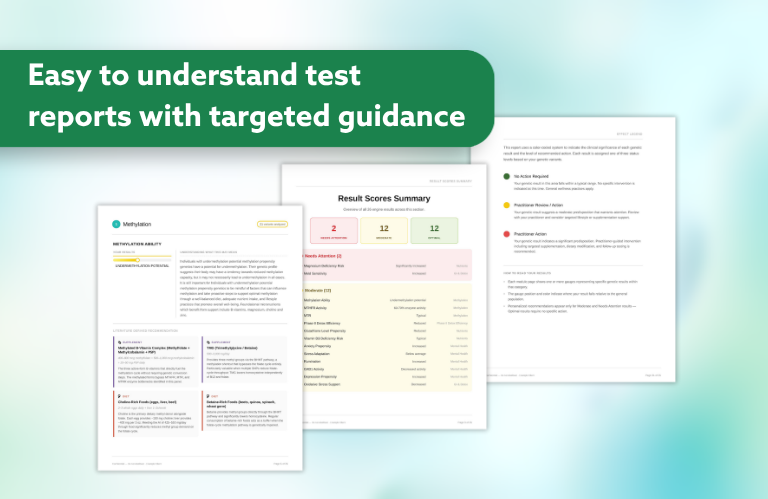
Click the image to view sample test reports
Polygenic Risk Scoring (PRS): A Higher-Resolution Genomic Context
Polygenic Risk Scoring (PRS) shifts the focus from individual variants to aggregate genetic patterns.
By evaluating and weighting multiple validated variants across a specific biological pathway or trait, a polygenic approach calculates relative genetic predisposition with far greater accuracy.[1,2]
| Genomic Approach | Core Question | Clinical Application |
|---|---|---|
| Single-SNP Analysis | “What does this isolated variant suggest?” | Identifies potential pathway bottlenecks, but lacks systemic context. |
| Polygenic Risk Scoring | “What is the aggregate impact across relevant variants?” | Delivers a weighted, high-resolution score of relative predisposition. |
Clinical Considerations with PRS
While PRS offers superior predictive depth, genetic risk is not clinical destiny. PRS estimates susceptibility; it does not capture real-time non-genetic inputs like diet, microbiome composition, toxin load, or stress.[1,6] Consequently, genomic profiles are most effective when integrated into a comprehensive clinical framework rather than used as standalone diagnostic tools.
Genomics vs. Functional Testing: Synergy in Practice
Genomic testing provides an unchanging biological blueprint, whereas functional biomarker testing offers a real-time snapshot of physiological function. Combining both allows clinicians to move from generalized protocols to high-precision medicine.
(DNA Signature)
or Potential Risk
Biomarker Testing
& Metabolic State
Interventions
Informed Care
Leveraging Genomic Insights to Drive Clinical Decisions
Integrating DNA Signature profiles into your clinical practice allows you to answer key clinical questions:
- Targeted Assessment: Where is this patient inherently most biologically vulnerable?
- Biomarker Correlation: Do current functional lab markers align with their genetic predispositions?
- Prioritized Therapies: Which specific dietary, nutrient, or lifestyle interventions will yield the highest impact?
- Focused Follow-Up: Which functional follow-up panels are necessary to evaluate whether a genetically susceptible pathway is currently impaired?
Rather than replacing standard diagnostics, genomic context helps you decide where to investigate deeper and how to allocate therapeutic resources effectively.
Introducing the DNA Signature Profiles
DNA Signature was developed to make genomic information more clinically approachable and actionable.
Rather than presenting practitioners with a long list of isolated SNPs to interpret independently, DNA Signature uses polygenic risk scoring to evaluate genomic patterns across clinically relevant pathways and translates those findings into three primary categories of support:
Specific Foods & Nutrients
Personalized dietary and nutritional strategies informed by genetic findings.
Lifestyle & Exercise
Individualized strategies related to factors such as stress response, recovery, metabolism, sleep, and physical performance.
Targeted Additional Testing
Recommendations for follow-up laboratory assessment that may help determine whether genetic predispositions are reflected in the patient’s current physiology.
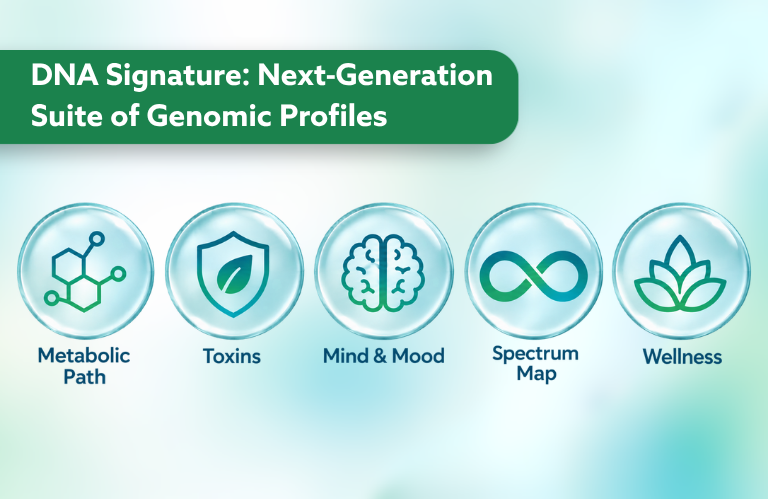
The DNA Signature suite includes five profiles designed for different areas of clinical focus.
DNA Signature – Metabolic Path
DNA Signature – Metabolic Path is designed as a genomic companion to the Mosaic Diagnostics Organic Acids Test (OAT), allowing practitioners to consider an individual’s underlying genetic tendencies alongside functional metabolic findings.
It evaluates genomic variations related to cellular energy production, nutrient utilization, neurotransmitter balance, gut health, methylation and detoxification, and nutrient needs.
The profile evaluates interconnected domains such as B-vitamin dynamics, mineral and antioxidant needs, methylation pathways, neurochemical regulation, mitochondrial function, oxidative defense, and environmental sensitivity.
DNA Signature – Toxins
DNA Signature – Toxins is designed as a genomic companion to Mosaic Diagnostics’ environmental toxin, mycotoxin, and heavy metal testing—helping practitioners evaluate both potential susceptibility and measured exposure or body burden when clinically appropriate. It focuses on genetic variations related to environmental toxin processing, oxidative stress response, antioxidant defense, and methylation pathways.
The profile examines areas such as Phase I and Phase II biotransformation, glutathione and NRF2-related antioxidant defense, environmental and chemical susceptibility, heavy metal-related pathways, mold response, and methylation.
DNA Signature – Mind & Mood
DNA Signature – Mind & Mood provides genomic insights into pathways associated with emotional regulation, cognitive health, stress resilience, and sleep.
By evaluating multiple interconnected pathways rather than reducing mental wellness to a single gene or neurotransmitter, the profile can help practitioners identify areas that may warrant greater clinical attention and personalize neuro-nutritional, lifestyle, and follow-up testing strategies.
DNA Signature – Spectrum Map
DNA Signature – Spectrum Map evaluates interconnected genomic pathways associated with neurodivergent traits, including autism spectrum conditions, ADHD, executive function variations, and sensory processing differences.
The profile is intended to provide additional insight into biological pathways that may help practitioners individualize nutritional, lifestyle, and functional-testing considerations within a broader clinical evaluation. It is important to note that genetic susceptibility does not establish a neurodevelopmental diagnosis.
DNA Signature – Wellness
DNA Signature – Wellness provides genomic insights into foundational vitality, metabolic potential, physical performance, recovery, and biological aging.
The profile evaluates interconnected areas including mitochondrial function, oxidative stress, telomere-related traits, glucose metabolism, macronutrient response, muscle mass, exercise recovery, musculoskeletal resilience, stress adaptation, and sleep.
For patients focused on healthy aging, metabolic health, fitness, or proactive wellness, these insights can help practitioners further individualize lifestyle strategies rather than relying solely on generalized recommendations.
From Genetic Information to Clinical Direction
The amount of genomic information now available can be both powerful and overwhelming. The challenge is no longer simply obtaining genetic data—it is determining which information is meaningful and what to do with it.
DNA Signature is designed to help bridge that gap.
For example, genomic findings may suggest increased susceptibility related to mitochondrial function. That finding alone does not establish that excessive oxidative stress is occurring. Instead, it may encourage the practitioner to examine the patient’s broader picture: environmental exposures, diet, inflammatory burden, lifestyle, symptoms, and relevant laboratory findings.
Likewise, genetic findings related to methylation, nutrient metabolism, mitochondrial function, detoxification, or stress response may help prioritize further assessment rather than automatically prompting an intervention.
Combining genotypic and phenotypic testing reduces clinical guesswork – enabling precise, targeted interventions that can accelerate better patient outcomes.
For practitioners interested in seeing how SNP testing and polygenic risk scoring can be incorporated into this broader clinical framework, explore Mosaic Diagnostics’ educational resource, Smarter Insights, Better Outcomes: Using SNP Testing to Accelerate Personalized Patient Care .
One Sample, Multiple Opportunities for Insight
DNA Signature testing uses a simple buccal swab collected from the inside of the cheek and can be done on anyone of any age. Initial sequencing is anticipated to take approximately 2–3 weeks. Once an individual’s DNA has been sequenced, additional DNA Signature profiles can be processed from the existing genomic data, with subsequent test turnaround estimated at approximately 48 hours.*
This provides practitioners with an opportunity to begin with the profile most relevant to the patient’s current goals and expand into additional areas of genomic insight as clinical needs evolve.
A More Personalized Path Forward
Genomics gives practitioners something unusual in laboratory medicine: information that can provide value long before—or independently of—an abnormal functional biomarker.
But the greatest value of genetic information may not come from attempting to predict exactly what will happen to a patient.
Instead, it goes back to help us answer a more practical question:
Where should we pay closer attention?
By moving beyond isolated variants and considering the collective influence of multiple genetic factors, DNA Signature provides a more comprehensive view of genetic predisposition. When those insights are interpreted alongside a patient’s history, symptoms, lifestyle, environmental exposures, and functional laboratory findings, they can help practitioners prioritize interventions and personalize care with greater context.
Genes are not destiny. They are one part of the story.
Understanding that part may help practitioners make the next chapter more personalized.
Explore the full DNA Signature Suite of Genomic Profiles.
*Turnaround times are estimates and are subject to change.
References
- Kullo IJ, Lewis CM, Inouye M, et al. Polygenic scores in biomedical research. Nat Rev Genet. 2022;23(9):524–532. doi:10.1038/s41576-022-00470-z.
- Chatterjee N, Shi J, García-Closas M. Developing and evaluating polygenic risk prediction models for stratified disease prevention. Nat Rev Genet. 2016;17(7):392–406. doi:10.1038/nrg.2016.27.
- Torkamani A, Wineinger NE, Topol EJ. The personal and clinical utility of polygenic risk scores. Nat Rev Genet. 2018;19(9):581–590. doi:10.1038/s41576-018-0018-x.
- National Human Genome Research Institute. Gene. Talking Glossary of Genetic Terms. Updated October 5, 2026.
- National Human Genome Research Institute. Single Nucleotide Polymorphisms (SNPs). Talking Glossary of Genetic Terms.
- Kullo IJ. Clinical use of polygenic risk scores: current status, barriers and future directions. Nat Rev Genet. 2026;27(3):246–263. doi:10.1038/s41576-025-00900-8.
- Koch S, Schmidtke J, Krawczak M, Caliebe A. Clinical utility of polygenic risk scores: a critical 2023 appraisal. J Community Genet. 2023;14(5):471–487. doi:10.1007/s12687-023-00645-z.
Looking for more clarity?
Complementary testing can provide further insight into root cause and guidance for therapeutic support.






This combination panel includes MycoTOX Profile® and The DUST Test for a comprehensive assessment of environmental exposure with biological markers of mycotoxin metabolites from a urine sample, and mold test results from a home dust collection sample.
Mycotoxins, produced by certain mold species, are some of the most prevalent toxins and can come from many sources, including buildings, vehicles, and food.