Updated by Courtney Middleton, ND August 2026 | Reviewed by: Avni Dalal, ND | Published: August 2026
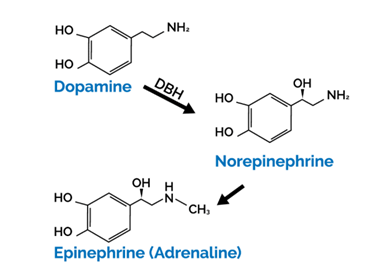
Dopamine beta-hydroxylase (DBH) is an enzyme crucial to the conversion of dopamine into norepinephrine – a transformation that has far-reaching consequences not only for autonomic function, but also for mood, cognition, and psychiatric health. Dopamine acts as the substrate for DBH in a manner that is similar to a key fitting into a lock. When functioning adequately, DBH converts dopamine into norepinephrine, maintaining balanced levels of both neurotransmitters throughout the system. When DBH function is impaired, a cascade of neurochemical and physiological disruptions can occur – ranging from orthostatic hypotension to depression and psychosis.
The DBH Enzyme Function
DBH catalyzes the β-hydroxylation of dopamine, incorporating a hydroxyl group to form norepinephrine. This reaction requires vitamin C and copper.1 DBH is found in circulation as both a soluble form released from synaptic vesicles and a membrane-bound form. Plasma and serum DBH levels are stable within individuals but vary between individuals, a variation estimated to be over 50% genetically determined.2 This variation is what makes circulating DBH a clinically relevant biomarker for assessment of noradrenergic tone as well as a potential indicator of vulnerability to psychiatric conditions.
The Effects of DBH Dysfunction
When DBH is not functioning optimally, regardless of cause, there will be a decreased conversion of dopamine to norepinephrine. This causes a subsequent rise in dopamine levels and decrease in norepinephrine. Symptoms commonly associated with this imbalance include: anxiety, depression, fatigue, low blood pressure, sluggish deep tendon reflexes, ptosis, hypotonic muscles, hyperflexible reflexes, weakened facial muscles, and increased stress response.
Conditions associated with DBH dysfunction are wide-ranging. Mental health disorders such as depression, anxiety, bipolar disorder, and schizophrenia have been associated with dysfunction in the DBH enzyme3,4. Other conditions include postural orthostatic tachycardia syndrome (POTS), exercise intolerance, fainting, autism spectrum disorder, ADHD, seizures, bipolar disorder, psychosis, other neurologic conditions, and alcoholism.5,6,7,8,9DBH and the Noradrenergic Basis of Mood
Insufficient norepinephrine can contribute to low mood, anhedonia, and fatigue, which are symptoms often associated with depression. Many antidepressants including serotonin-norepinephrine reuptake inhibitors (SNRIs) and tricyclics exert their effects in part by enhancing noradrenergic signaling, consistent with the hypothesis that low norepinephrine is pathogenic in depression. DBH impairment, by limiting norepinephrine biosynthesis, can therefore be clinically relevant as an upstream contributor to these downstream mood disturbances.

Causes of DBH Dysfunction
Clostridia Toxins
When Clostridia metabolites are elevated, dysfunction of DBH can ensue. The most common of these toxins (4-cresol and HPHPA) are tyrosine derivatives produced by Clostridium species in the gastrointestinal tract. Because these compounds are structurally similar to dopamine, they competitively and irreversibly bind to the DBH enzyme, blocking its ability to convert dopamine to norepinephrine.¹⁰ An Organic Acids Test (OAT) can assess whether a patient has elevated clostridia metabolites and can also provide insight into neurotransmitter status via HVA, VMA, and HVA/VMA ratios.
Cofactor Deficiencies: Vitamin C and Copper
DBH requires vitamin C and copper as essential cofactors. Without adequate levels of these nutrients, the enzyme cannot perform efficiently. Vitamin C and copper levels have been shown to be decreased in patients with various neurological disorders, and populations at risk include those with eating disorders, inadequate micronutrient nutrition, or arsenic toxicity — the latter of which has been correlated with decreased vitamin C and copper.2 The Copper + Zinc Profile can guide appropriate supplementation, as zinc competes with copper for absorption. Clinicians should also be mindful that high-dose vitamin C supplementation can potentiate oxalate production in those with elevated oxalates.
Genetic Polymorphisms (SNPs)
If clostridia toxins are not elevated and cofactors are at normal levels, there is the possibility of a genetic predisposition to decreased enzyme function. There are several single nucleotide polymorphisms (SNPs) in the DBH gene have been identified that affect the enzyme’s expression and activity. The two best-characterized functional polymorphisms are a 19-bp insertion/deletion in the promoter region and a -1021C/T SNP, both of which significantly influence plasma DBH activity levels and have been linked to psychiatric risk.¹¹
Assessment of DBH Function
A multimodal testing approach is often considered for patients presenting with symptoms consistent with DBH dysfunction:
Organic Acids Test (OAT): The first-line screen for DBH dysfunction. The neurotransmitter section assesses HVA (homovanillic acid), VMA (vanillylmandelic acid), and the HVA/VMA ratio. In DBH dysfunction, it is common for HVA to be elevated, VMA proportionally decreased, and the HVA/VMA ratio elevated This indicates impaired dopamine-to-norepinephrine conversion. Clostridia markers (4-cresol and HPHPA) are also assessed.
Heavy Metals Testing: To rule out arsenic toxicity and other metals that may deplete vitamin C and copper, impairing DBH function.
How to Approach DBH Dysfunction
Addressing DBH dysfunction is often aimed at addressing underlying factors.
Clostridia overgrowth: If elevated clostridia toxins (4-cresol or HPHPA) are identified on the OAT, treatment aimed at balancing the gut microbiome is considered, followed by re-evaluation of DBH function and symptomatology. Resolution of clostridia overgrowth may restore DBH activity and alleviate associated mood and neurological symptoms.
Cofactor repletion: Supplementation with vitamin C and copper can support DBH enzyme activity in individuals with deficiencies.
Pharmacological intervention: For individuals with confirmed decreased DBH functionality, droxidopa (Northera), a synthetic amino acid precursor to norepinephrine, is an FDA-approved prescription option. It converts dopamine to norepinephrine by aromatic L-amino acid decarboxylase, bypassing the need for DBH and providing an alternative source of norepinephrine. ¹²
Conclusion
DBH sits at a critical biochemical junction, managing the balance between dopamine and norepinephrine throughout the nervous system. Its impairment, whether from clostridia toxin inhibition, cofactor deficiency, or genetic polymorphism, can have significant consequences for autonomic function, neurological health, and mood. Reduced DBH activity has been associated with major depressive disorder, psychotic depression, and bipolar disorder severity, while elevated activity has been observed in certain psychotic states including PTSD with psychotic features. Comprehensive functional assessment of DBH, including the OAT, and metals testing provides clinicians with the tools needed to understand and address the root causes of DBH-related dysfunction.

References
- Rahman MK, Rahman F, Rahman T, Kato T. Dopamine-β-Hydroxylase (DBH), its cofactors and other biochemical parameters in the serum of neurological patients in Bangladesh. J Clin Biochem Nutr. 2009;45(3):292-297. doi:10.3164/jcbn.09-18
- Kurian MA, Gissen P, Smith M, Heales S, Clayton PT. The monoamine neurotransmitter disorders: an expanding range of neurological syndromes. Lancet Neurol. 2011;10(8):721-733. doi:10.1016/S1474-4422(11)70141-7; see also: Weinshenker D. Dopamine beta-hydroxylase and its genetic variants in human health and disease. J Neurochem. 2019;152(5):600-617. doi:10.1111/jnc.14893
- Beuger M, van Kammen DP, Kelley ME, Yao J. Dopamine turnover in schizophrenia before and after haloperidol withdrawal. CSF, plasma, and urine studies. Neuropsychopharmacology. 1996;15(1):75-86. doi:10.1016/0893-133X(95)00180-O
- . Cross AJ, Crow TJ, Perry EK, et al. Reduced dopamine-beta-hydroxylase activity in Alzheimer’s disease. BMJ. 1981;282(6258):93-94. doi:10.1136/bmj.282.6258.93
- Meltzer HY, Cho HW, Carroll BJ, Russo P. Serum dopamine-beta-hydroxylase activity in the affective psychoses and schizophrenia. Arch Gen Psychiatry. 1976;33(5):585-591. doi:10.1001/archpsyc.1976.01770050011001
- Li Y, Zhao X, Tang H, et al. Association between dopamine beta-hydroxylase 19-bp insertion/deletion polymorphism and major depressive disorder. J Mol Neurosci. 2014;54(2):259-264. doi:10.1007/s12031-014-0339-y
- Li W, Zhao D, He J, et al. Reduced plasma dopamine-β-hydroxylase activity is associated with the severity of bipolar disorder: a pilot study. Front Psychiatry. 2021;12:566091. doi:10.3389/fpsyt.2021.566091
- Cubells JF, Sun X, Li W, et al. A polymorphism in the dopamine beta-hydroxylase gene is associated with “paranoid ideation” in patients with major depression. Biol Psychiatry. 2002;51(5):358-363. doi:10.1016/s0006-3223(01)01162-x
- Hamner MB, Gold PB. Plasma dopamine beta-hydroxylase activity in psychotic and non-psychotic post-traumatic stress disorder. Psychiatry Res. 1998;77(3):175-181. doi:10.1016/s0165-1781(98)00001-1
- Shaw W. Increased urinary excretion of a 3-(3-hydroxyphenyl)-3-hydroxypropionic acid (HPHPA), an abnormal phenylalanine metabolite of Clostridia spp. in the gastrointestinal tract, in urine samples from patients with autism and schizophrenia. Nutr Neurosci. 2010;13(3):135-143. doi:10.1179/147683010X12611460763968
- Li Y, Zhao X, Tang H, et al. Association between dopamine beta-hydroxylase 19-bp insertion/deletion polymorphism and major depressive disorder. J Mol Neurosci. 2014;54(2):259-264. doi:10.1007/s12031-014-0339-y
- Kaufmann H, Norcliffe-Kaufmann L, Palma JA. Droxidopa in neurogenic orthostatic hypotension. Expert Rev Cardiovasc Ther. 2015;13(8):875-891. doi:10.1586/14779072.2015.1057504