EU Message: This test is not available to persons established in the EU.
Decode the Pathways Driving Metabolic Health
DNA Signature – MetabolicPath evaluates foundational genomic variations governing cellular energy production, nutrient utilization, neurotransmitter balance, gut health, methylation/detoxification, and nutrient needs. By assessing interconnected physiological pathways rather than isolated variants, it provides a comprehensive blueprint of baseline biochemistry to help practitioners uncover potential underlying drivers of persistent functional imbalances.
Even when standard biomarkers appear within normal reference ranges, subtle genetic variations can significantly alter metabolic throughput. DNA Signature – MetabolicPath bridges this gap, translating complex genetic data into an actionable strategy for targeted nutrient, dietary, lifestyle, and testing protocols.
Designed as the genetic companion to the MosaicDX Organic Acids Test (OAT).
Why Use the DNA Signature – Metabolic Path Profile?
DNA Signature – Metabolic evaluates the foundational genetic variations that govern cellular energy production, nutrient metabolism, neurotransmitter balance, and systemic resilience. By assessing interconnected physiological pathways rather than isolated variants, this panel provides a comprehensive blueprint of a patient’s baseline biochemistry, helping practitioners uncover potential underlying drivers of persistent functional imbalances.
Core Functional Domains Evaluated
Nutrient Utilization & Cofactor Requirements
B-Vitamin Dynamics: Maps functional processing and utilization tendencies for key B vitamins, essential co-factors for things like mitochondrial function, gut health, detoxification, methylation and neurotransmitter synthesis and breakdown.
Essential Mineral Status: Identifies genetic predisposition to depletion of essential minerals like Iron and Magnesium.
Antioxidant & Micronutrient Propensity: Evaluates genetic tendencies toward challenges with absorbing and utilizing key antioxidants like vitamin C, vitamin D, and CoQ10.
Methylation & Neuro-Metabolic Balance
Methylation: Assesses core drivers of methylation pathways, including MTHFR, MTR, and MTRR, which support DNA repair, detoxification, and cellular regeneration.
Neuro-Chemical Regulation: Evaluates COMT activity (methylation) and GAD1 activity to understand neurotransmitter turnover, catecholamine clearance, and GABA synthesis.
Neuro-Behavioral Tendencies: Maps genetic associations related to anxiety, depression, rumination, and OCD behaviors.
Stress Adaptation: Identifies individual Stress Phenotypes and biological Stress Adaptation capacity to explain distinct thresholds for physical and psychological stress.
Cellular Energy, Defense & Tissue Integrity
Mitochondrial Output & Stamina: Evaluates mitochondrial function and CoQ10 production pathways driving cellular ATP generation.
Oxidative Defense & Detoxification: Assesses SNPs impacting endogenous glutathione levels, overall Phase II Detox efficiency, and capacity to buffer against oxidative stress.
Barrier Function & Environmental Sensitivity: Pinpoints genetic susceptibility to gut permeability and heightened mold sensitivity.
Our high-complexity laboratory is committed to delivering accurate and reliable results in coordination with these top licensure programs:
Analytes
From a single easy-to-collect buccal swab you will receive a personalized polygenic risk score for the following traits:
MTHFR Activity
MTR
MTRR
COMT (Methylation)
Phase II Detox Efficiency
Vitamin B12
Vitamin B6
Vitamin B9 (Folate)
Vitamin C Propensity
Vitamin D Deficiency Risk
Iron Deficiency Risk
Magnesium Deficiency Risk
CoQ10
Glutathione
Anxiety Propensity
Depression Propensity
GAD1 Activity
OCD Likelihood
Rumination
Stress Adaptation
Stress Phenotype
Gut Permeability
Mold Sensitivity
Oxidative Stress
Mitochondrial Function
Sample Reports
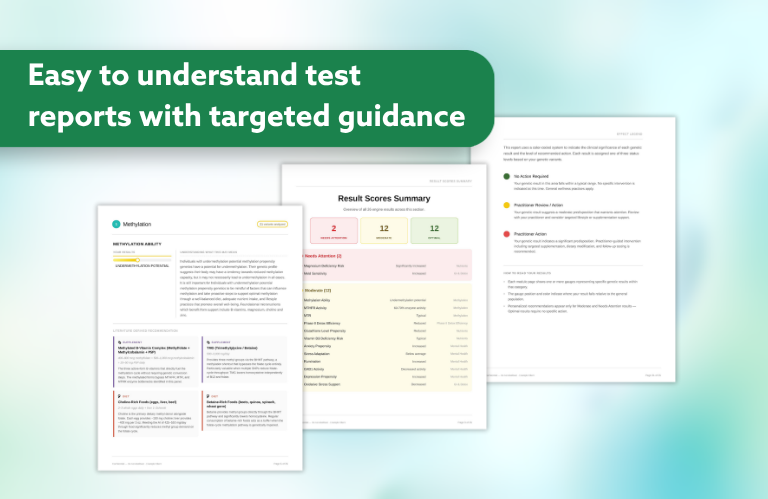
The DNA Methylation Profile report aids clinical support for patients by pinpointing SNPs that could potentially impact health and disease risk.
MosaicDX offers patient-friendly sample collection kits that simplify testing. Our kits include visual, step-by-step instructions for test preparation and sample collection, personalized shipping cards, and pediatric collection bags if needed. With MosaicDX, patients can easily collect samples for testing with confidence and accuracy.
No, we do not. A genetic carrier refers to an individual who has inherited a recessive allele that has been shown to be responsible for an autosomal recessive disease or trait. A genetic carrier only has one recessive allele so while they do not show signs or symptoms of the trait or disease, they are able to pass along the recessive gene to their child. Our genetic testing is for screening purposes only to assess risk or predisposition for certain traits associated with health and wellness.
No. We do not use patient samples for further research or testing. We may use your de-identified and anonymized data to help improve our algorithm and reports. Your data will not be sold or shared to or with any 3rd parties/commercial interests.
Yes, we can delete the patient’s raw genetic sequence at any time. Please note that applicable federal and state laws require us to retain your patient report and the subset of your data that was used to generate that report for a specified period of time. We will be happy to delete any and all of your data that we are legally allowed to delete upon request. Please submit your request here.
We implement rigorous selection criteria when choosing which genes or SNPs to include in our panels. The selection and validation criteria are based upon peer-reviewed studies that show a significant association between the SNP variant and trait or condition, the magnitude of the odds ratio (OR) or hazard ratio (HR) to assess risk related to the variant, as well as the population or populations the gene and SNP variant were studied in, the population size, and replication of findings.
A genotype refers to the actual inherited genetic material of an individual that can influence or determine certain characteristics or traits. A phenotype is how the genotype is actually expressed, that is the observable or measurable characteristics or traits of an individual.
SNP is also called a Single Nucleotide Polymorphism. Your DNA consists of 4 main building blocks (nucleotides), Adenine (A), Thymine (T), Guanine (G), and Cytosine (C). In certain locations within your DNA, one person may have an A, whereas another may have a G. This difference in the base pair is often called a variant. This variant is an SNP.
In most situations, you do not have to resubmit a DNA buccal swab sample if you later want to order additional panels. The only time a new DNA buccal swab would need to be resubmitted is if the assay has had significant changes, or the patient previously requested that their DNA sequencing results be deleted.
Patients are sent a DNA Signature Collection Kit containing instructions, 1 cheek swab, a DNA Sample Envelope and a prepaid return envelope and biohazard zip-lock bag. Instructions can also be found on our website on the DNA Signature Profiles web page, along with an easy-to-follow video.
A person’s polygenic risk score is a statistical calculation based on the presence or absence of multiple genomic variants without taking environmental or other factors into account
Different states have regulations that define the scope of practice for practitioners. It is the practitioner’s responsibility to abide by these rules. Check with your state board of health to determine any restrictions related to laboratory testing. Please note, Mosaic Diagnostics does not offer testing in New York.
Once you have opened your account, you have the options of ordering kits to stock in your office or drop-ship kits directly to your patients through your MosaicDX portal.
Watch our short tutorial videos on how to conveniently